Product Description & Technical Details
Product Description
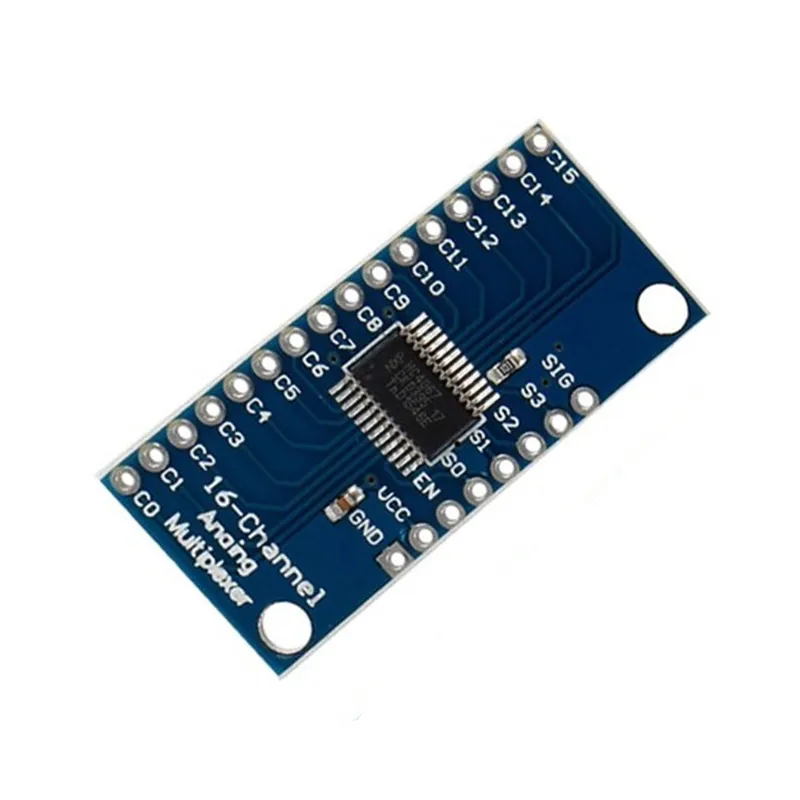
The CD74HC4067 16-Channel Multiplexer Breakout is the ultimate solution for microcontrollers with limited I/O pins. This module acts like a high-speed rotary switch; it allows you to connect up to 16 different inputs (analog or digital) to a single pin on your Arduino or ESP32. By using four binary select pins (S0-S3), you can choose which of the 16 channels is connected to the common "SIG" pin at any given time. Because it is bi-directional, it can also be used as a Demultiplexer to route one signal to 16 different outputs. It is a favorite at Robogears for reading massive arrays of sensors, controlling large LED matrices, or managing multiple potentiometers on a MIDI controller.
Key Highlights
Massive Pin Expansion: Expand a single analog or digital pin to 16, requiring only 4 control pins (S0-S3) plus an optional Enable pin.
Bi-Directional Signal Flow: Works in both directions (1-to-16 or 16-to-1), allowing it to handle both sensor inputs and output signals like PWM.
Wide Compatibility: Works perfectly with 3.3V systems (like ESP32/Raspberry Pi) and 5V systems (like Arduino Uno/Mega).
High-Speed Switching: The CMOS technology allows for very fast channel switching, making it suitable for high-frequency signal sampling.
Enable Pin (EN): Includes an Active-Low Enable pin which, when pulled HIGH, disconnects all channels, effectively "turning off" the multiplexer.
Technical Specifications
Propagation Delay: 15ns (at 5V)
Frequency Bandwidth: Up to 80 MHz
Operating Temperature: -55°C to +125°C
Breakout Size: 40mm x 18mm
Pin Pitch: Standard 2.54mm
Installation Tip from Robogears
To select a channel, you must provide a binary code to the S0, S1, S2, and S3 pins. For example, to read channel C5, you would set the select pins to binary 5 (S0=HIGH, S1=LOW, S2=HIGH, S3=LOW). If you are using this to read analog sensors, be aware of the internal 70 $\Omega$ on-resistance; for most sensors, this is negligible, but for very high-precision measurements, it may require a small offset correction in your code. Always connect the EN pin to Ground to keep the module active.
Note: This product is the CD74HC4067 Breakout Board. Header pins are usually included but not soldered. Product images are for illustration purposes only.