Product Description & Technical Details
Product Description
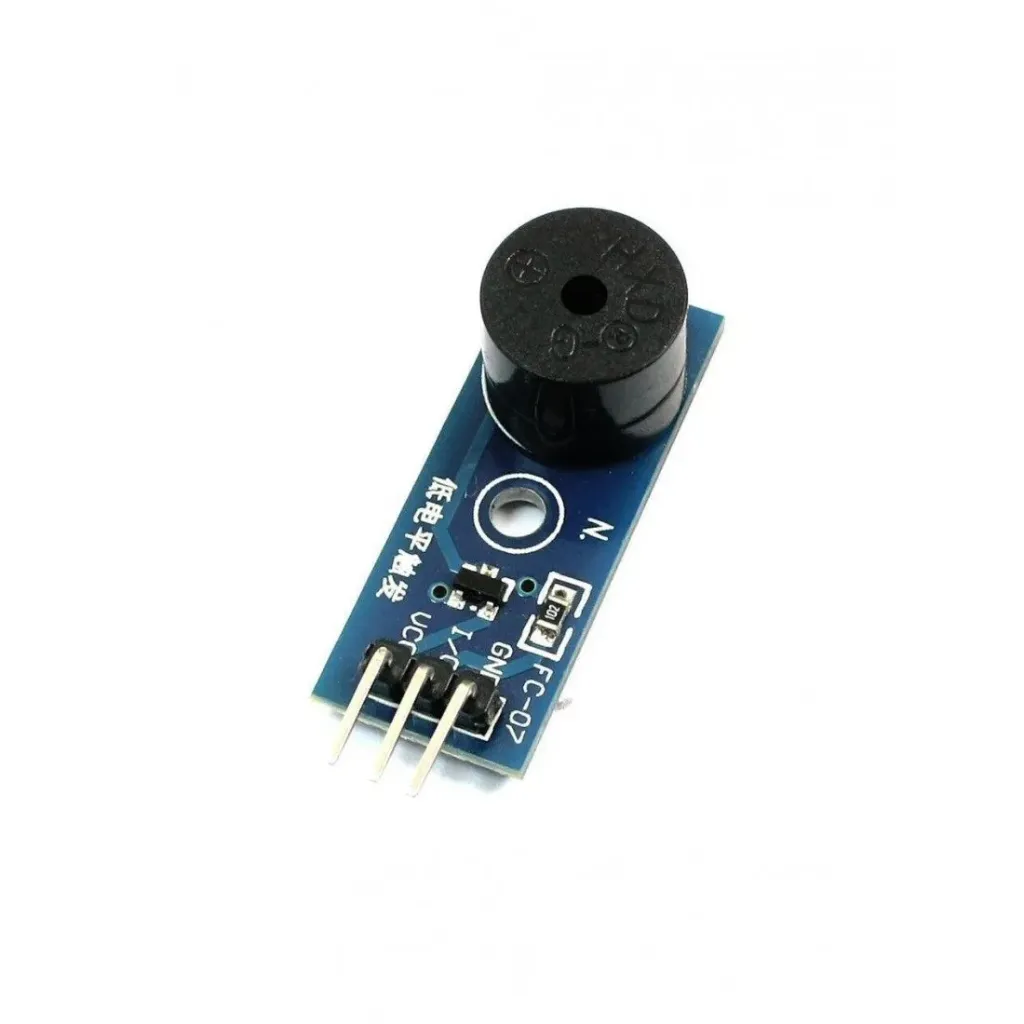
The Active Buzzer Alarm Module is a high-decibel audio signaling device designed for easy integration with microcontrollers. Unlike a standalone buzzer, this module includes an S8550 PNP transistor driver circuit on the PCB. This design allows the buzzer to draw its operating current directly from the power supply rather than the microcontroller's I/O pin, which prevents damage to your board. Being an "Active" buzzer, it has a built-in vibration source; you only need to provide a logic signal to trigger a continuous "beep" sound. It is an ideal alert component for security systems, fault indicators, and interactive toys.
Key Highlights
Transistor Driven: The onboard S8550 transistor acts as a switch, allowing a low-power logic signal from an Arduino or ESP32 to control a high-current buzzer safely.
Low-Level Trigger: Most of these modules are designed to sound when the I/O pin is pulled LOW (0V), making it compatible with various sensor outputs and microcontroller logic.
Stable Tone: Because the oscillator is internal, the buzzer produces a consistent 2.3kHz frequency without requiring the microcontroller to generate a PWM or tone signal.
Wide Voltage Range: Works perfectly on both 3.3V (modern IoT boards) and 5V (standard Arduino) logic levels.
Mounting Hole: The PCB includes a 3mm fixed bolt hole for easy installation inside project enclosures or on robotic chassis.
Technical Specifications
Current Consumption: < 30mA
Resonant Frequency: 2300Hz ± 300Hz
Operating Temperature: -20°C to +70°C
Dimensions: 32mm x 13mm
Pin Spacing: 2.54mm (Breadboard friendly)
Installation Tip from Robogears
When wiring this module, ensure you verify the trigger type. If your code uses digitalWrite(pin, LOW) and the buzzer sounds, it is a Low-Level Trigger module. For the best sound quality, remove the protective adhesive sticker from the top of the buzzer after your final assembly. If you are using this in a battery-powered project, remember that the transistor driver minimizes the strain on your MCU, but the buzzer still consumes around 30mA when active, so keep the "on-time" brief to conserve energy.
Note: This is a 3-pin module (VCC, GND, Signal). A 2-pin buzzer is a standalone component, whereas this is a complete circuit. Product images are for illustration purposes only.