Product Description & Technical Details
Product Description
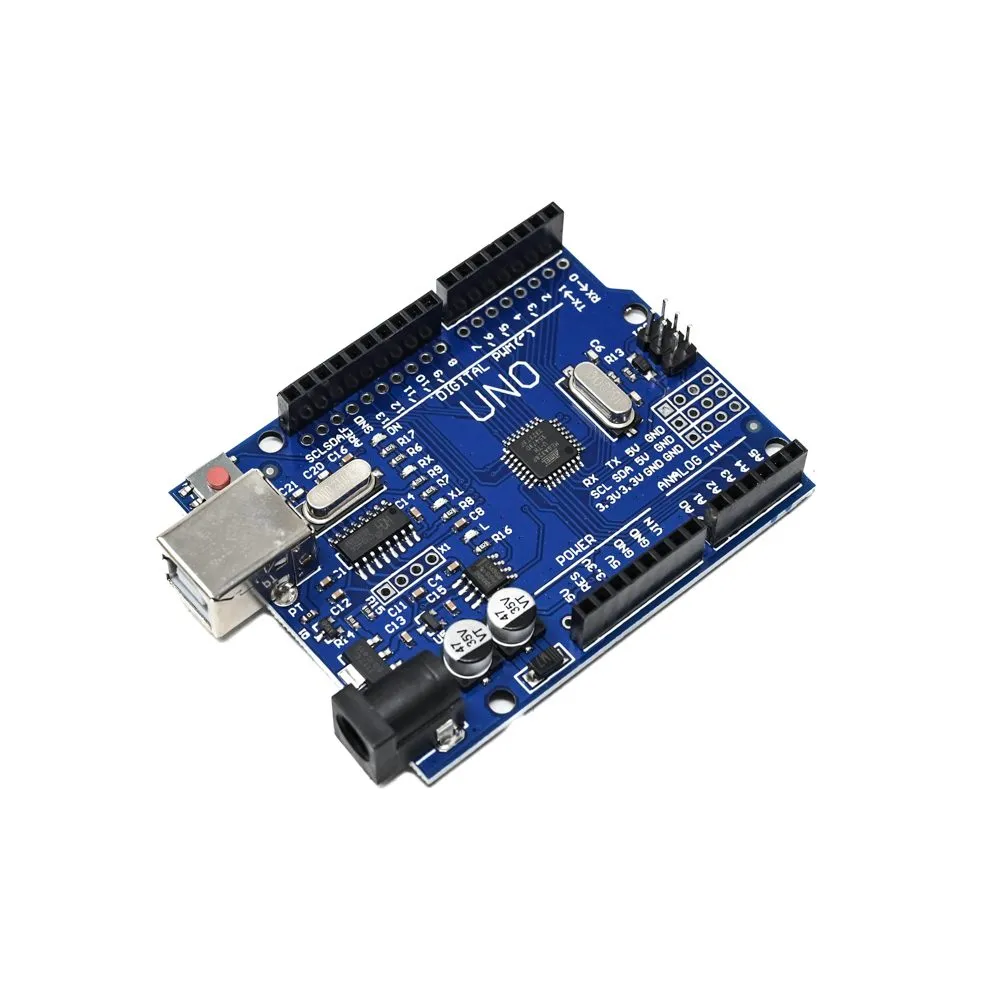
The Uno R3 with CH340G is the most popular and widely used development board in the world of electronics and DIY robotics. It is the perfect entry point for beginners and a reliable tool for professionals. Based on the ATmega328P microcontroller, this board provides a balanced set of inputs and outputs to control everything from simple LEDs and sensors to complex robotic arms and home automation systems. This specific version utilizes the cost-effective CH340G USB-to-Serial converter, ensuring a stable connection to your computer for programming via the Arduino IDE. With its standardized "shield" footprint, it is compatible with thousands of expansion boards available in the market today.
+1
Key Highlights
Universal Shield Compatibility: The standardized pin header layout allows you to stack "shields" (expansion boards) for motor control, WiFi, Ethernet, and LCD displays directly on top.
Easy Programming: Fully compatible with the Arduino IDE (Integrated Development Environment) and supports C/C++, making it easy to find millions of free tutorials and libraries online.
Robust Power Design: Features both a USB port and a 5.5mm DC barrel jack, with an onboard voltage regulator that safely handles external power inputs from 7V to 12V.
Multiple PWM Channels: Includes 6 Pulse Width Modulation (PWM) pins, essential for controlling the speed of DC motors or the precise position of servo motors.
User-Friendly Feedback: Equipped with onboard status LEDs for Power (ON), Serial communication (TX/RX), and a programmable user LED connected to Pin 13.
Technical Specifications
Flash Memory: 32 KB (0.5 KB used by bootloader)
SRAM: 2 KB
EEPROM: 1 KB
DC Current per I/O Pin: 40 mA
Interfaces: UART, SPI, I2C (TWI)
Dimensions: 68.6mm x 53.4mm
Weight: ~25 Grams
Installation Tip from Robogears
This board uses the CH340G serial chip. If your computer does not recognize the board under "Ports" in the Arduino IDE, you will need to download and install the CH340 drivers (available for Windows, Mac, and Linux). For external power, we recommend a 9V 1A or 12V 1A DC adapter. Avoid powering the board with more than 12V through the DC jack, as the onboard regulator may overheat. When uploading your first sketch, select "Arduino Uno" from the Boards menu and ensure the correct Serial Port is selected.
Note: The product images provided are for illustration purposes only. The actual product may vary slightly in terms of design, color, or component layout due to manufacturing updates, but technical specifications will remain as described.