Product Description & Technical Details
Product Description
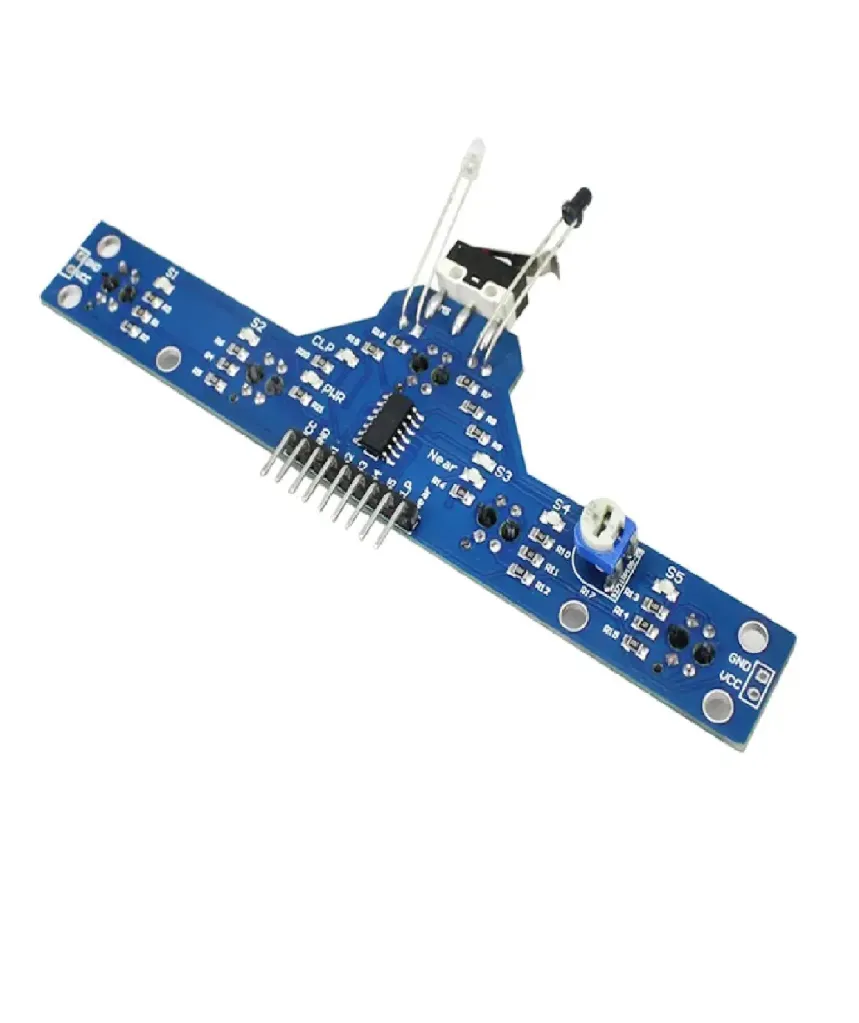
The BFD-1000 Five-Channel Tracking Module is an all-in-one sensing solution designed for advanced line-following robots. Unlike single or triple-sensor modules, the BFD-1000 integrates five high-sensitivity TCRT5000 infrared sensors in a single row, allowing your robot to detect complex intersections, sharp turns, and varied line widths with much higher resolution. It uses infrared reflection to distinguish between dark lines (low reflection) and light surfaces (high reflection). In addition to line tracking, the module features a forward-facing infrared sensor for obstacle detection and a front-mounted touch switch (bump sensor) for physical collision sensing, making it the ultimate navigation hub for autonomous vehicles.
Key Highlights
Superior 5-Channel Accuracy: The wide array of five sensors provides the "fine-tuning" capability needed for PID-based line following, ensuring smoother movements at high speeds.
Integrated Obstacle Detection: Includes a front-facing IR proximity sensor, allowing the robot to "see" objects in its path while simultaneously following a line.
Hardware Debouncing: Features built-in Schmitt triggers and comparator ICs, which convert raw analog IR signals into clean, noise-free digital high/low outputs for the microcontroller.
Sensitivity Adjustment: Each sensor's threshold can be fine-tuned using the onboard potentiometers to adapt to different lighting conditions and floor materials.
Status LEDs: Each of the seven channels (5 tracking + 1 obstacle + 1 touch) has its own indicator LED, providing immediate visual feedback during debugging.
Technical Specifications
Output Voltage: Logic 0 (Line Detected) / Logic 1 (No Line) — Typical Configuration
Detection Distance (Line): 0mm to 40mm
Detection Distance (Obstacle): 0mm to 50mm (Adjustable)
Dimensions: 128mm x 28mm
Mounting Holes: M3 compatible for easy chassis attachment
Installation Tip from Robogears
To use this module effectively with an Arduino, connect the 7 signal output pins to any digital I/O pins. In your code, reading these pins as digitalRead() will return a 0 or 1. If you are building a fast line-follower, use the PID (Proportional-Integral-Derivative) control algorithm; the 5-sensor data allows you to calculate the "error" (how far the robot is from the center) much more accurately than a 3-sensor setup. Ensure the module is mounted roughly 1cm to 2cm above the ground for the best contrast detection.
Note: This product is the BFD-1000 Integrated Sensor Module. Connecting wires and robot chassis are sold separately. Product images are for illustration purposes only.