FAQ
1. What does this project do?
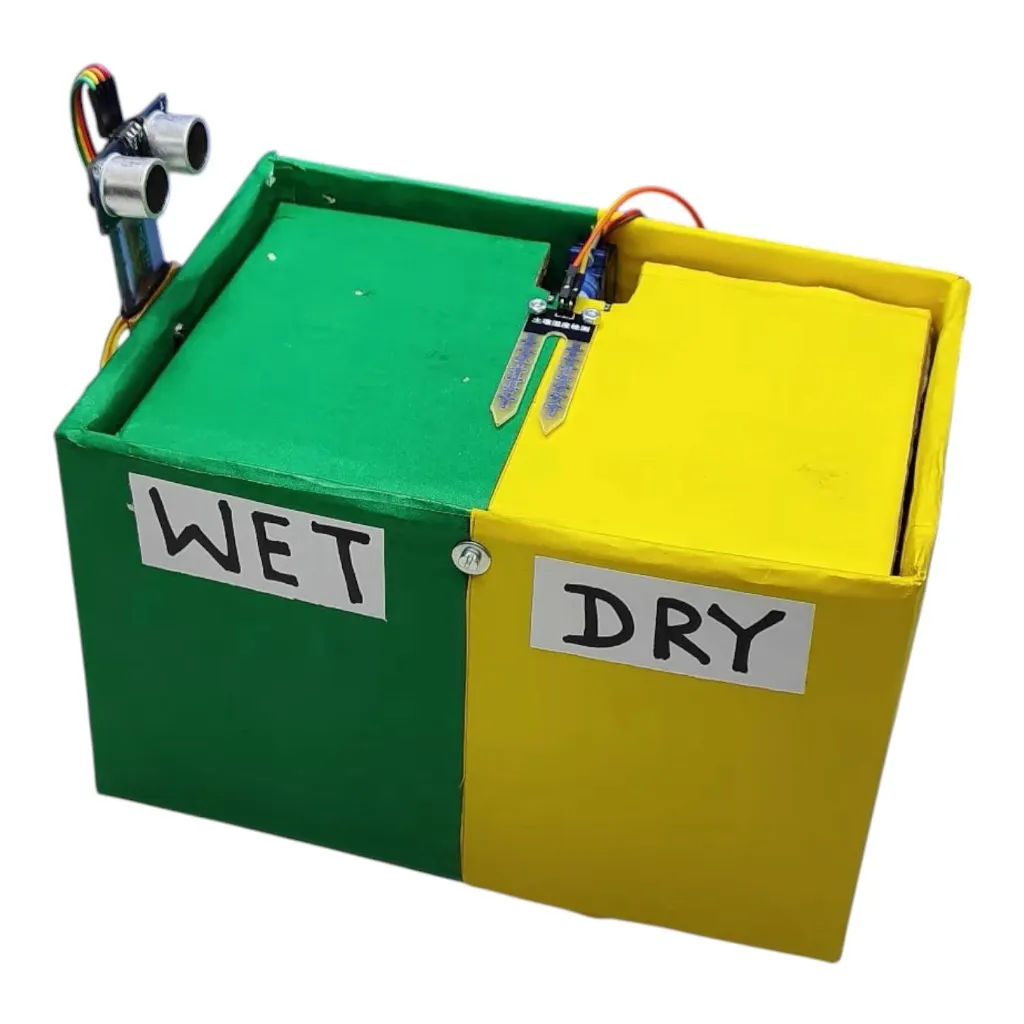
The project demonstrates automatic classification and mechanical segregation of waste into:
2. Is the Arduino included?
Yes.
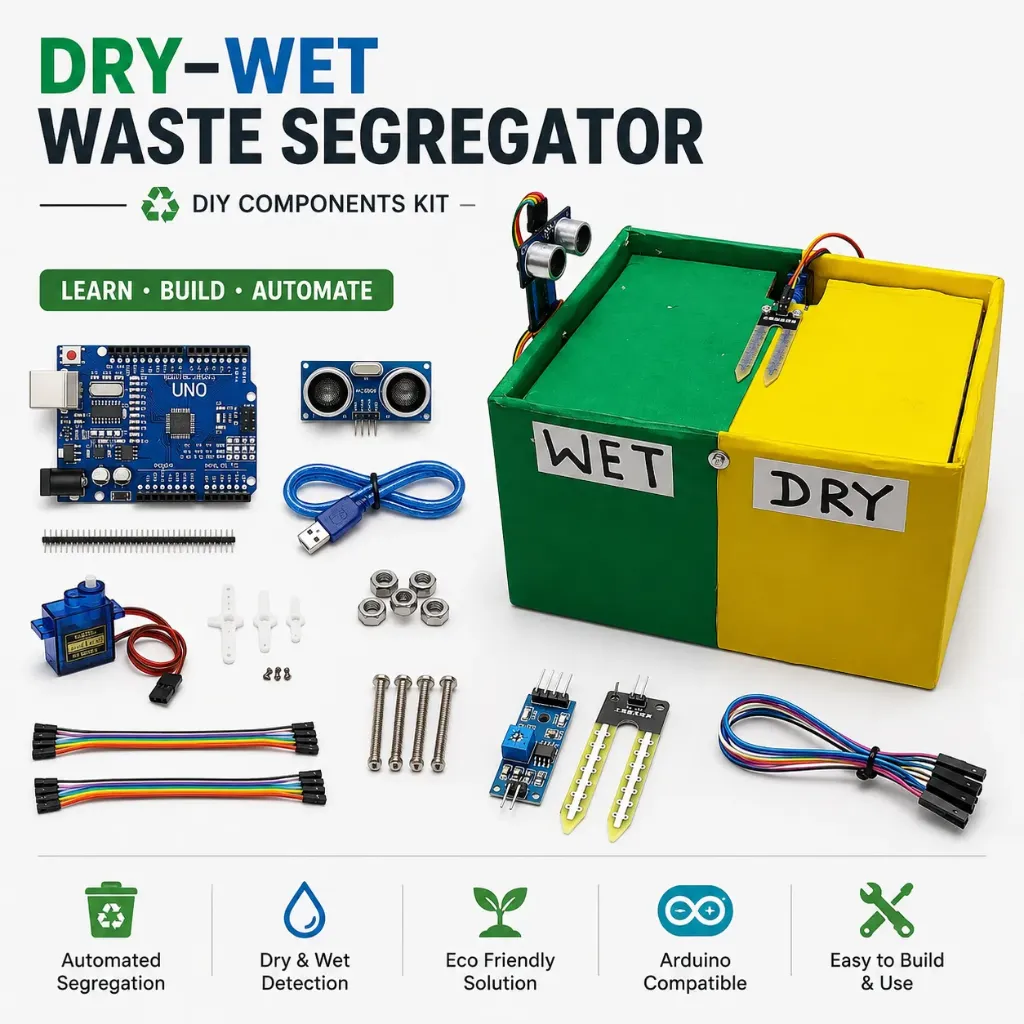
The package includes:
1 × Arduino UNO SMD Compatible Board
3. Is the Arduino pre-programmed?
Yes.
The Arduino is supplied code loaded / pre-programmed, so uploading code is not required for initial operation.
4. Which sensors are included?
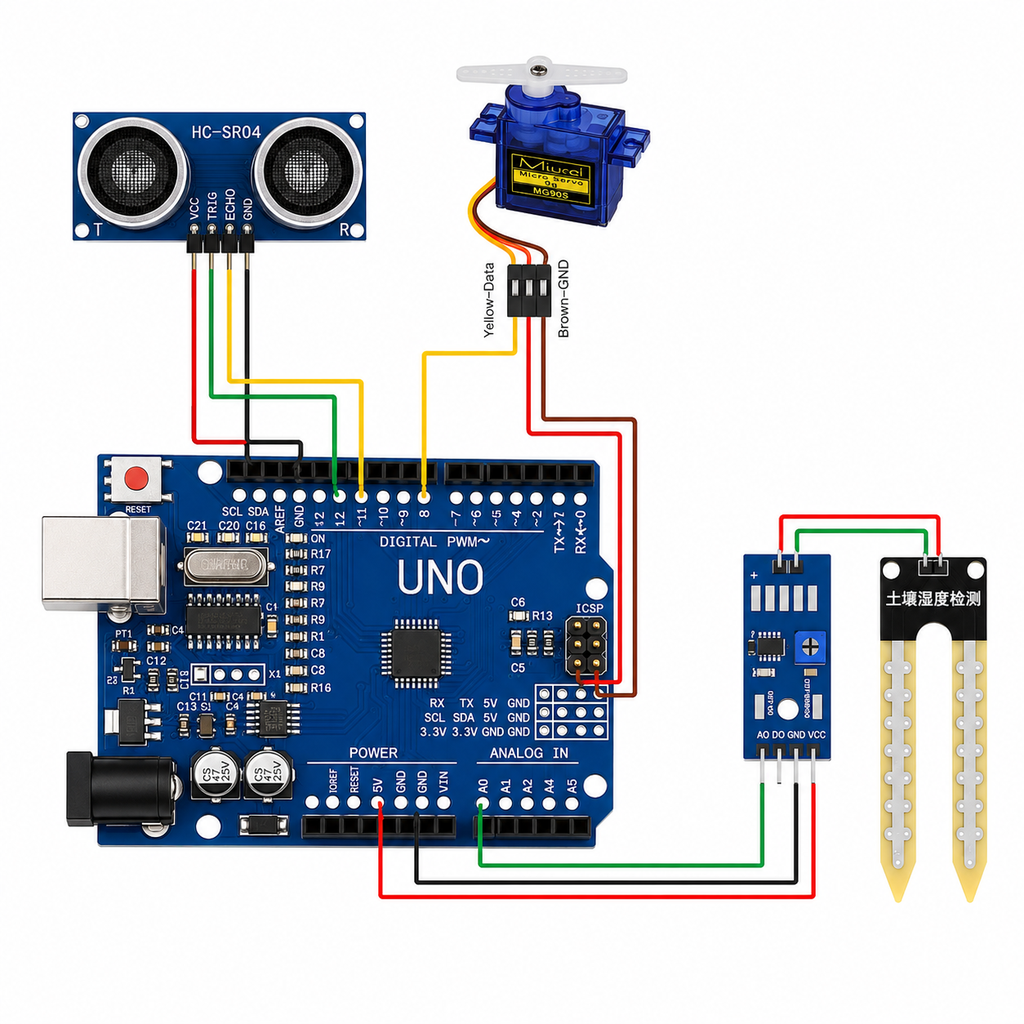
The kit includes:
1 × Soil Moisture Sensor
1 × Ultrasonic Sensor
5. Why are two sensors used?
The ultrasonic sensor is used for object/waste detection in the project, while the moisture sensor helps classify the material according to its moisture condition.
6. Which motor is included?
The package includes:
1 × 9g Servo Motor
It can operate the lightweight mechanical sorting mechanism.
7. Is the complete dustbin included?
No.
This is a components kit.
The customer needs to build the actual waste-segregator body, collection bins and sorting structure.
8. Is a battery included?
No battery is listed in the current package contents.
A suitable project power arrangement must therefore be provided separately when required.
9. Is an LCD included?
No.
The standard Dry & Wet Waste Segregator Components Kit does not list an LCD or I2C module.
10. Does this kit detect metal waste?
No.
This version is designed for dry and wet waste segregation.
RoboGears has a separate Dry, Wet & Metal Waste Segregator Type-2 Kit for a more advanced three-category project.
11. Do I need coding knowledge?
No coding is required for initial operation because the Arduino is supplied code loaded.
Arduino programming becomes useful when modifying thresholds, servo positions or project behaviour.
12. Can I change the moisture threshold?
Yes.
The Arduino program can be modified to adjust the classification logic according to the project's sensor readings and test materials.
13. Why is my dry waste being detected as wet?
Possible causes include:
Moisture sensor contamination
Residue from previous testing
Incorrect threshold
Damp material
Inconsistent sensor contact
Clean the sensor and recalibrate using representative samples.
14. Can this classify every type of real-world waste accurately?
No.
This is an educational prototype that demonstrates moisture-based dry/wet classification.
Real municipal waste classification is considerably more complex and can require multiple sensing technologies and industrial sorting systems.
15. Is assembly required?
Yes.
The customer needs to perform:
Wiring
Sensor mounting
Servo mounting
Mechanical fabrication
Alignment
Calibration
Testing
The Arduino itself is supplied pre-programmed.
16. Can the components be reused?
Yes.
The Arduino, ultrasonic sensor, moisture sensor, servo and jumper wires can be reused in many compatible Arduino, robotics and automation projects.
Important Note
This kit is intended for educational, DIY, STEM, environmental-awareness and prototyping applications.
It demonstrates the principle of moisture-based dry/wet waste segregation and should not be represented as an industrial waste-classification system.
The supplied Arduino is pre-programmed / code loaded, so coding is not required for initial operation. Mechanical construction, wiring, sensor positioning, calibration and testing are still required.
Actual component colour, PCB layout or equivalent hardware revision may vary according to available stock while maintaining the intended project functionality.