🔧 Prototyping and Engineering Tips from RoboGears
1. Keep the Verified Core Specifications
The reliable purchasing specifications are:
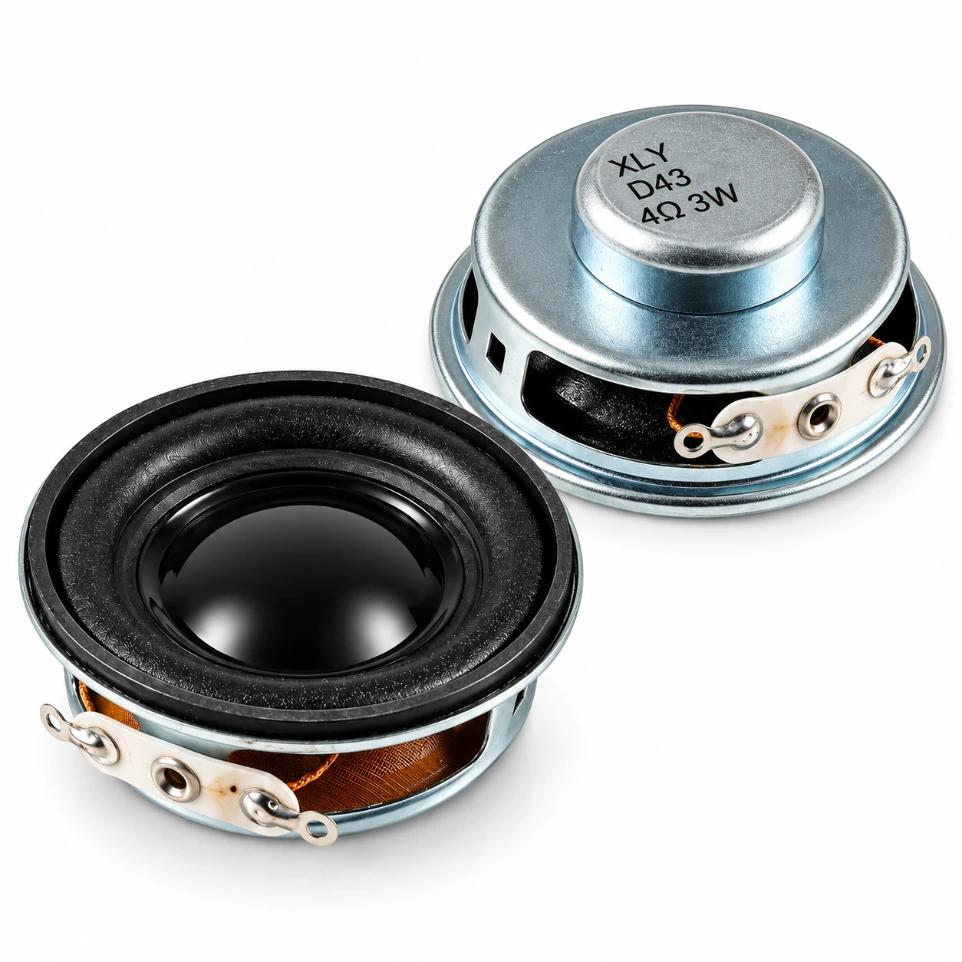
40mm + 4Ω + 3W + Full-Range
These are the most important details for most DIY customers.
2. Remove “Neodymium/Ferrite”
The current listing says:
High-Strength Neodymium/Ferrite
This is contradictory because neodymium and ferrite are different magnet materials.
Until the actual magnet is identified, use:
Magnet Type: Not Specified
or remove the field entirely.
3. Treat 100Hz–20kHz as Unverified
The current listing gives:
100Hz–20kHz Approx.
Without a manufacturer frequency-response curve or datasheet, this should not be presented as an exact product specification.
Remove it until verified.
4. Remove the Estimated Voice-Coil Diameter
The current page states:
~13mm to 16mm
This is a broad estimate rather than a verified specification.
Remove it.
5. Remove the Estimated Fs
The current page states:
Fs ~150Hz
Without measurement or manufacturer documentation, remove this specification.
6. Remove the Estimated Sensitivity
The current page states:
~82dB ±3dB
Sensitivity requires defined measurement conditions.
Remove it until verified.
7. Don't Guess Cone and Surround Materials
The current page says:
treated paper or composite cone
and:
rubber/foam surround
The use of “or” indicates that the exact construction is not established.
Remove these material claims unless confirmed from the actual product.
8. PAM8403 Is a Good Application
A PAM8403-based stereo amplifier is a practical choice for a small 4Ω speaker project.
However, amplifier output depends on:
Supply voltage
Load impedance
Signal level
Distortion limit
Avoid assuming that every PAM8403 board will deliver exactly 3W continuously.
9. Don't Connect Directly to Arduino / ESP32 GPIO
Use:
Microcontroller / Audio Source → Amplifier → Speaker
A normal GPIO pin is not designed to directly drive a 4Ω speaker at useful audio power.
10. 5V Does Not Connect Directly to the Speaker
A common project architecture is:
5V Supply → Amplifier → Speaker
not:
5V Supply → Speaker
11. A 3.7V Battery Can Power a Suitable Amplifier
A single Li-ion cell may power certain compatible low-voltage amplifier circuits.
The speaker itself still connects to the amplifier output.
12. Stereo Polarity Matters
When using two speakers:
Incorrect relative polarity can reduce bass and alter stereo imaging.
13. BTL Amplifier Outputs Require Care
Many small Class-D amplifiers use bridge-tied-load outputs.
Do not connect Left and Right speaker negative terminals together unless the amplifier documentation specifically permits it.
14. Enclosure / Baffle Helps
A small speaker mounted completely free-air can suffer acoustic cancellation between the front and rear radiation.
A suitable baffle or enclosure can improve practical performance.
However, don't claim that a speaker “will not work” without an enclosure.
15. Don't Publish an Arbitrary Box Volume
The current:
0.2–0.5L
recommendation should be removed until driver parameters are known.
16. Solder Carefully
When soldering directly to speaker terminals:
Use an appropriately sized soldering iron
Avoid prolonged heating
Support the wire mechanically
Avoid damaging the flexible leads to the cone
17. Keep Metal Debris Away
Magnetic particles and metal filings can be attracted toward the speaker's magnetic assembly.
Keep the speaker away from workshop debris during assembly.
18. Protect the Cone
Do not press the cone or dust cap unnecessarily.
Mechanical deformation can damage a small speaker.
Engineering Principle
For this small driver:
Correct 4Ω Amplifier + Controlled Power + Proper Mounting + Suitable Enclosure/Baffle
matter more than unverified sensitivity or frequency-response numbers.