FAQ
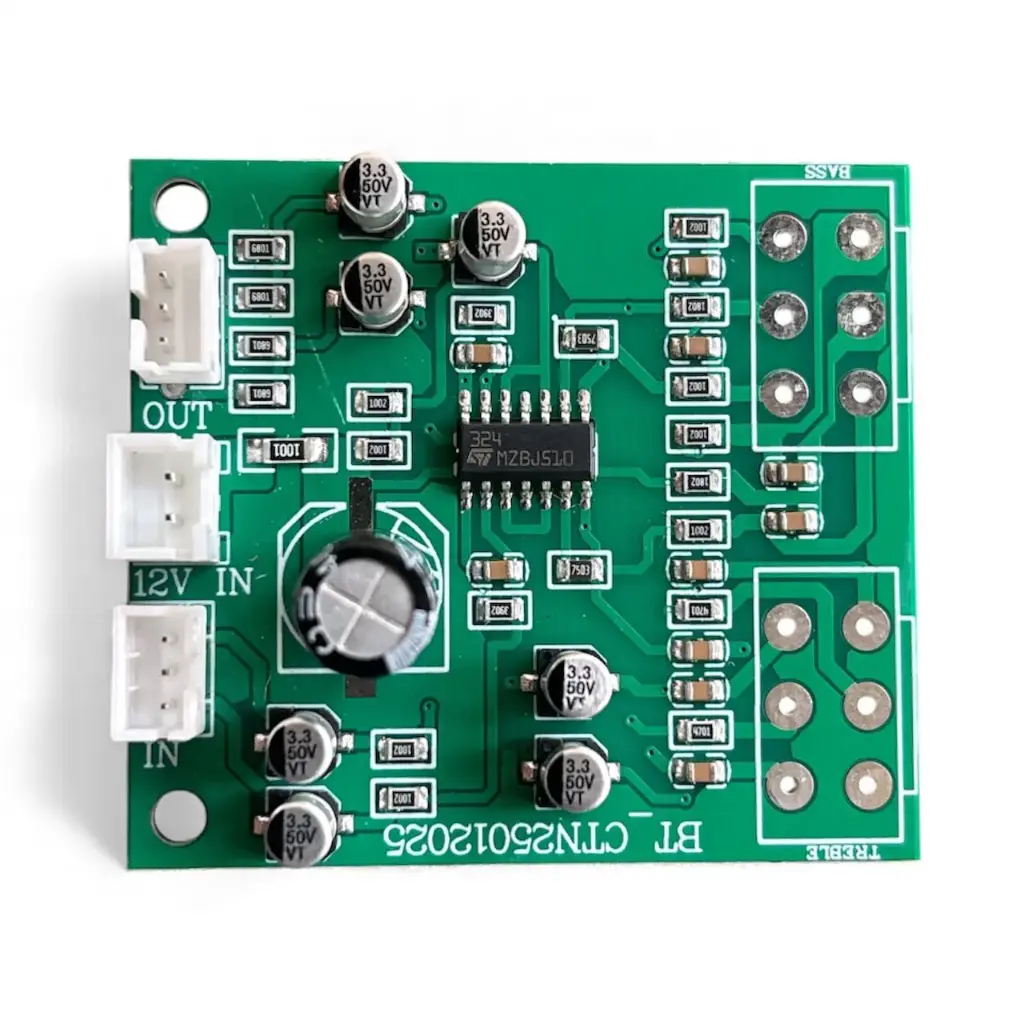
1. What is the LM324E board?
It is a stereo audio preamplifier and active tone-control board providing volume, bass and treble adjustment.
2. Which IC does it use?
The current RoboGears specification identifies an:
LM324 Quad Operational Amplifier
3. What is the operating voltage?
DC 12V–24V
4. Can I use a 12V supply?
Yes.
12V is within the specified operating range.
5. Can I use a 24V supply?
Yes.
24V is the upper end of the board's published operating range.
6. Can I use 5V?
The RoboGears board is specified for 12V–24V DC, so 5V operation should not be assumed.
7. Can I use 36V?
No.
36V exceeds the specified board operating range.
8. Is this a stereo board?
Yes.
It is specified as a 2.0-channel stereo preamplifier.
9. Does it control volume?
Yes.
10. Does it control bass?
Yes.
11. Does it control treble?
Yes.
12. How many potentiometers are provided?
Three:
13. Is it a power amplifier?
No.
It is a preamplifier/tone-control module.
14. Can I connect speakers directly?
No.
Normal passive speakers require an external audio power amplifier.
15. What is the correct connection order?
Audio Source → LM324E → Power Amplifier → Speakers
16. Can I connect a Bluetooth receiver to it?
Yes.
A compatible Bluetooth receiver with line-level audio output can feed the LM324E input.
17. Can I connect an MP3 decoder?
Yes, provided the decoder provides a compatible line-level audio output.
18. Can I use it with TPA3116D2?
Yes, as a tone-control/preamplifier stage before a compatible TPA3116D2 amplifier.
19. Can I use it with TPA3255?
Yes, as a line-level tone-control stage before a compatible TPA3255 amplifier.
20. Can I use it with PAM8403?
It can be used ahead of a compatible PAM8403 amplifier, provided the power and signal-level requirements of both boards are handled correctly.
21. What is the published frequency response?
The current RoboGears listing states:
20Hz–20kHz
22. Does it increase bass?
The bass control allows adjustment of the low-frequency portion of the audio signal.
Excessive boost should be avoided if it causes clipping or speaker distortion.
23. Does it increase treble?
The treble control adjusts the high-frequency portion of the audio signal.
24. Can I use it in a DIY Bluetooth speaker?
Yes.
A typical system is:
Phone → Bluetooth Receiver → LM324E → Power Amplifier → Speakers
25. Can I use it in a home amplifier?
Yes.
It is suitable as a stereo tone-control stage in compatible DIY home-audio systems.
26. Can I use it in a car-audio project?
The board's 12V operating capability makes it potentially suitable for appropriately designed automotive audio projects.
Automotive electrical systems can experience voltage transients, so proper power regulation/protection is recommended for permanent installations.
27. Why do I hear hum?
Possible causes include:
28. Can a capacitor reduce hum?
If the hum originates from power-supply ripple, additional supply filtering may help.
The current RoboGears page suggests a 1000µF capacitor across the power input as one possible troubleshooting step.
29. Why does the sound distort when I increase bass?
Heavy bass boost can increase signal amplitude and reduce available headroom.
Reduce bass, volume or source level and check the downstream amplifier.
30. Does it have Bluetooth built in?
No Bluetooth function is specified.
Use an external Bluetooth receiver if wireless audio is required.
31. Does it have USB playback?
No USB playback function is specified.
32. Does it have FM radio?
No FM tuner is specified.
33. Does it have a speaker amplifier?
No.
A separate power amplifier is required.
34. What is included?
1 × LM324E SMD Bass Treble Preamplifier Board
35. Is a power supply included?
No power supply is specified as included.
36. Are speakers included?
No.
37. Is a power amplifier included?
No.
Important Note
The LM324E board is a stereo preamplifier and tone-control module, not a speaker power amplifier.
Use it between a compatible line-level audio source and an external power amplifier.
Disclaimer
Actual audio performance depends on the power supply, source level, amplifier input characteristics, grounding, wiring and overall system design.
Do not exceed the board's specified 12V–24V DC operating range.