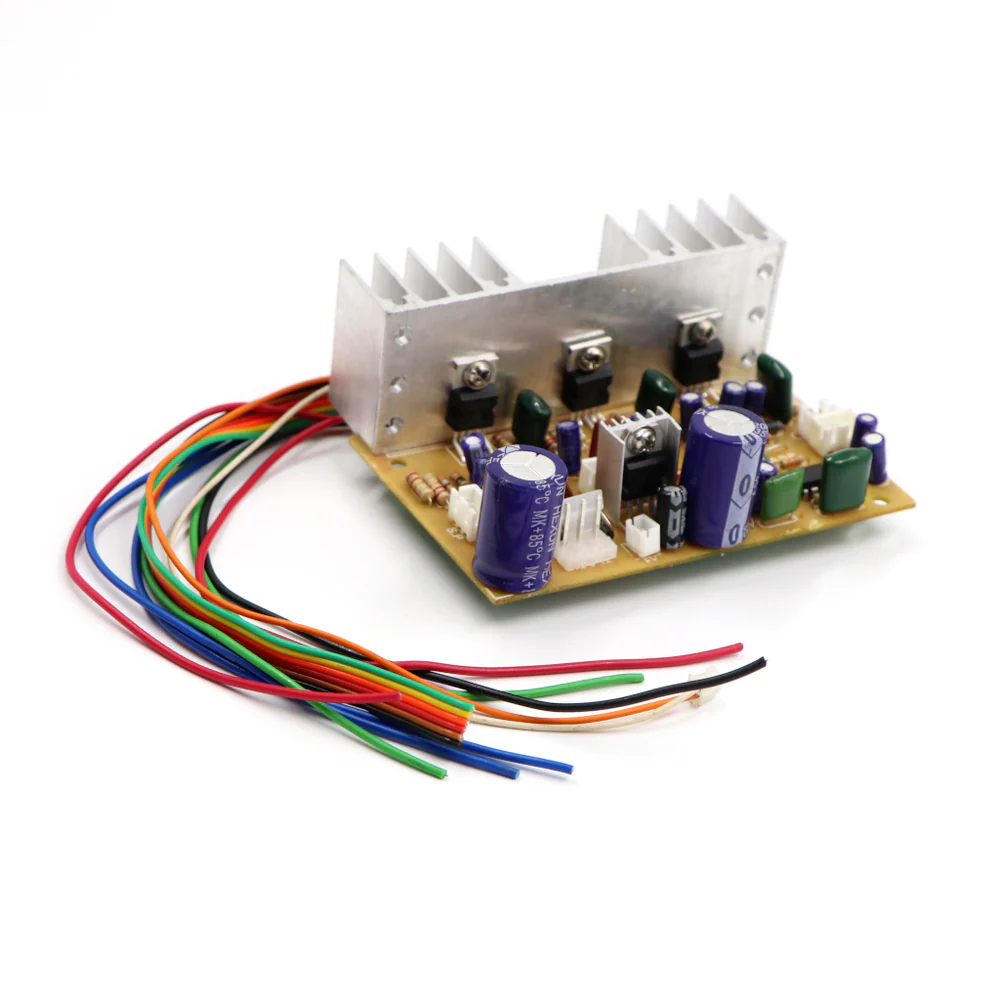
🔧 Prototyping and Engineering Tips from RoboGears
1. This Board Requires 12-0-12V AC
This is the most important requirement.
Normal power input:
12V AC – 0V – 12V AC
from a centre-tapped transformer.
Do not treat this as a standard 12V DC amplifier board.
2. Do Not Connect 230V AC Directly
Use an isolated step-down transformer:
230V AC → Transformer → 12-0-12V AC → Amplifier
Never connect mains directly to the amplifier's low-voltage input.
3. Do Not Recommend Bypassing the Rectifier to Customers
Although technically possible to modify some amplifier circuits for an appropriate DC supply, this depends on the actual PCB topology.
For a retail product listing, the safe instruction is:
Use the specified 12-0-12V AC transformer input.
Do not advise customers to bypass the bridge rectifier unless a verified modification guide exists for this exact PCB.
4. Use a Suitable Transformer
A:
12-0-12V / 2A–3A
transformer is recommended.
For higher-volume operation and stronger bass transients, a suitable 3A transformer provides more supply-current headroom.
5. Understand the TDA2030A Rating
The original TDA2030A manufacturer specifies approximately:
18W into 4Ω at ±16V with 0.5% distortion
under defined test conditions.
Do not describe each TDA2030A as a standalone 35W amplifier.
6. 35W Requires a Different Circuit
The manufacturer describes higher-power circuits where the TDA2030A operates as a driver with additional external power transistors.
That is different from the standalone IC output rating.
7. Treat 15W + 15W + 30W as Published Board Output
Until the exact PCB topology and measured test conditions are available, describe:
15W + 15W + 30W
as the board's published output specification.
Do not call it guaranteed continuous RMS.
8. The 7805 Output Is Useful but Limited
The onboard 7805 can provide:
5V DC
for suitable low-power accessories.
Possible applications include:
Bluetooth receiver
MP3 decoder
USB decoder panel
However, the 7805 is a linear regulator.
Its available current depends strongly on:
Input voltage
Current draw
PCB heatsinking
Regulator temperature
Do not advertise it as a high-current 5V supply.
9. Class-AB Generates Heat
Unlike modern high-efficiency Class-D amplifiers, Class-AB designs dissipate substantial heat at higher output.
Maintain airflow around the TDA2030A heatsinks.
10. Heatsinks Can Become Hot
Warm or hot heatsinks during high-output operation are normal to an extent.
Excessive temperature, repeated thermal shutdown or rapid overheating can indicate:
Incorrect speaker load
Poor heatsink contact
Excessive supply voltage
Output short circuit
Poor ventilation
11. Grounding Is Important
Traditional Class-AB amplifier boards can be sensitive to grounding and wiring layout.
For low hum:
Keep audio wiring short
Keep transformer wiring away from audio inputs
Use a sensible star-ground arrangement where practical
Keep mains wiring away from signal wiring
Use shielded audio cable for longer low-level connections
12. Hum Is Usually 50Hz in India
For Indian 50Hz mains systems, mains-related hum is normally referred to as:
50Hz hum
or potentially 100Hz ripple hum after full-wave rectification.
Avoid calling it “60Hz hum” in an India-focused product listing.
13. Keep the Transformer Away From the Audio Input
Transformer magnetic fields can induce hum into:
Input wiring
Tone-control circuitry
Potentiometer wiring
Maintain physical separation where possible.
14. Speaker Impedance Matters
Published compatibility:
4Ω–8Ω
Lower impedance generally increases current and heat demand.
15. Bluetooth Can Be Added Easily
A useful architecture is:
5V Auxiliary Output → Bluetooth Receiver Power
and:
Bluetooth L/R Audio → Amplifier Input
Verify the Bluetooth module's voltage and current requirements first.
Common Troubleshooting
Loud Hum
Check:
Transformer placement
Grounding
Audio-input wiring
Filter capacitors
Signal cable routing
Bass Distorts at Higher Volume
Check:
Amplifier Gets Very Hot
Check:
Speaker impedance
Heatsink contact
Supply voltage
Ventilation
Output short circuits
Bluetooth Module Resets
The 5V regulator may be overloaded or overheating.
Check module current consumption and 5V rail stability.
One Channel Does Not Work
Check:
Speaker
Potentiometer wiring
Input signal
TDA2030A
Output wiring
Engineering Principle
For this traditional Class-AB amplifier:
Correct Transformer + Good Grounding + Compatible Speakers + Proper Cooling
are the keys to reliable performance.