FAQ
1. What is the Gold-A502?
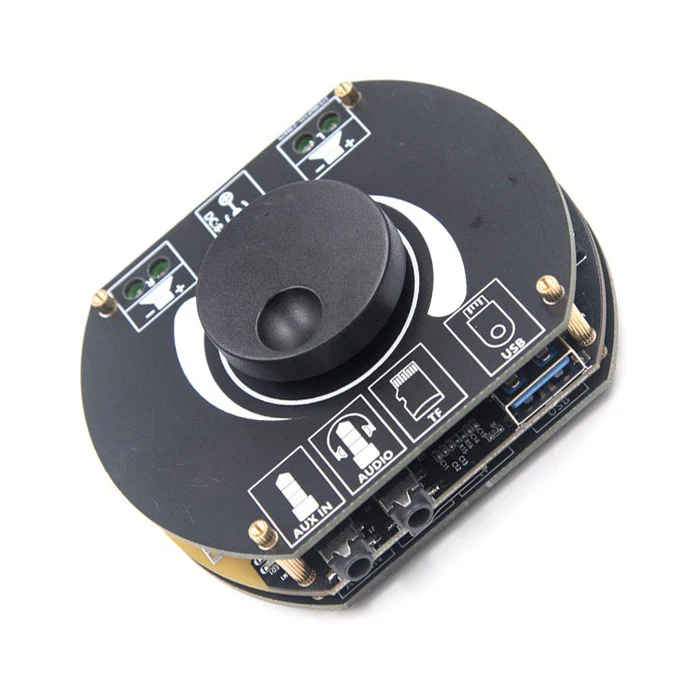
The Gold-A502 is a compact 2.0-channel Class-D stereo amplifier and audio playback board with Bluetooth, AUX, USB and TF-card support.
2. What is the output power?
Published maximum output:
30W + 30W
under suitable operating conditions.
3. Is it stereo?
Yes.
It provides:
Left channel
Right channel
4. Is it a 2.1-channel amplifier?
No.
The Gold-A502 is a 2.0-channel stereo amplifier without a dedicated amplified subwoofer channel.
5. Does it have Bluetooth?
Yes.
The board supports:
Bluetooth 5.0
6. What is the Bluetooth range?
Published range is approximately:
10–15 metres in favourable open conditions
Actual range depends on the installation environment.
7. Does it support AUX?
Yes.
AUX wired audio input is supported.
8. Does it support USB flash drives?
Yes.
The A502 supports USB-drive audio playback.
9. Does it support TF / microSD cards?
Yes.
TF-card audio playback is supported.
10. Does it require a separate MP3 decoder?
Not for its built-in Bluetooth, USB, TF-card and AUX playback functions.
These functions are already integrated into the A502.
11. What power supply does it require?
Supported range:
DC 8V–24V
Recommended practical range:
12V–24V DC
12. Which power supply should I use for higher output?
For higher-power operation, approximately:
24V / 3A–5A
is recommended.
13. Can I use a 12V adapter?
Yes.
12V is within the supported range, but maximum available output will be lower than with a suitable 24V supply.
14. Can I use a 24V adapter?
Yes.
24V is within the specified range.
Use a regulated supply with sufficient current capacity.
15. Which speakers can I use?
Published compatibility:
4Ω–8Ω passive speakers
16. Can I use 4Ω speakers?
Yes.
4Ω speakers are supported.
17. Can I use 8Ω speakers?
Yes.
8Ω speakers are supported, although obtainable maximum output can differ from a 4Ω configuration.
18. Does it have volume control?
Yes.
The current RoboGears listing specifies an integrated volume-control knob.
19. Does it have bass and treble controls?
Dedicated adjustable bass and treble controls are not specified for the standard Gold-A502.
An external tone-control/pre-amplifier can be added if required.
20. Does it have a dedicated subwoofer output?
No.
This is a two-channel stereo amplifier.
21. What are the dimensions?
Approximately:
80.5 × 67 × 35mm
22. Does it have a heat sink?
Yes.
The board incorporates a large heat sink for thermal management.
23. Can I build a Bluetooth speaker with it?
Yes.
A basic configuration is:
Gold-A502 + DC Power Supply + Left Speaker + Right Speaker
Bluetooth audio functionality is already built in.
24. Can it work without a phone?
Yes.
USB flash-drive and TF-card playback allow compatible stored music to be played without continuously using a smartphone as the audio source.
25. Is a power supply included?
No.
The standard package contains the amplifier board only.
26. Are speakers included?
No.
Speakers must be purchased separately.
27. Is the USB drive included?
No.
A USB flash drive is not included in the standard package.
28. Is a TF/microSD card included?
No.
A memory card must be purchased separately if required.
29. Which amplifier IC does it use?
The current RoboGears listing identifies the board as using dual TPA3116D2 amplifier ICs.
However, because generic A502 board revisions can vary, RoboGears recommends confirming the markings on the actual physical stock before using the exact IC count as a guaranteed specification.
30. Does 30W + 30W mean 60W continuous output?
Not necessarily.
The published 30W + 30W figure represents the board's maximum advertised output under suitable operating conditions.
Actual continuous output depends on:
Supply voltage
Available current
Speaker impedance
Input signal
Thermal conditions
Important Safety Note
Use DC power only.
Observe correct polarity.
Do not exceed 24V DC.
Use 4Ω–8Ω speakers.
Prevent speaker-output short circuits.
Disconnect power before modifying wiring.
Maintain airflow around the heat sink.
Use a regulated supply with adequate current capacity.
Disclaimer
The 30W + 30W specification represents the published maximum output under suitable operating conditions and should not be interpreted as guaranteed continuous RMS output at every supply voltage or speaker impedance.
Actual output depends on power-supply voltage/current, speaker load, audio signal, wiring and thermal conditions.
PCB colour, heat-sink design, decoder components, IC revision, connectors and minor component placement may vary between manufacturing batches.