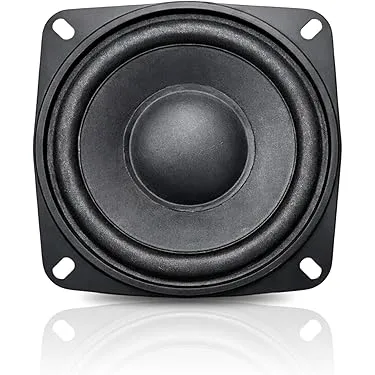
🔧 Prototyping and Engineering Tips from RoboGears
1. Match the Amplifier to 4Ω
The speaker's nominal impedance is:
4Ω
The amplifier must support a 4Ω load.
2. Don't Automatically Recommend a 30W–50W Amplifier
The speaker is published as:
20W RMS
A higher-powered amplifier can be used only when its actual output is appropriately controlled.
For beginners, recommending a 30W–50W amplifier without explaining output control can increase the risk of damaging the speaker.
3. Amplifier Wattage Is Not Continuously Forced Into the Speaker
A 50W amplifier does not continuously deliver 50W simply because a 20W speaker is connected.
Actual output depends on:
Signal
Volume
Supply voltage
Load impedance
However, excessive volume can allow a higher-powered amplifier to exceed the speaker's safe power handling.
4. Use a Low-Pass Filter for Subwoofer Applications
For a dedicated subwoofer channel, use:
LPF / Subwoofer Output
A crossover frequency somewhere in the low-frequency region may be appropriate depending on the satellite speakers and enclosure.
Do not claim that exactly 150Hz is universally optimal.
5. A 4-Inch Driver Has Physical Bass Limitations
A compact 4-inch driver can provide useful bass reinforcement, but it should not be marketed as equivalent to a large 8-inch, 10-inch or 12-inch subwoofer.
Driver size, excursion and enclosure all influence low-frequency output.
6. Enclosure Design Matters
A properly designed enclosure can significantly improve:
Bass response
Mechanical control
Efficiency
Overall sound quality
7. Don't Calculate an Enclosure Using Speaker Size Alone
Proper enclosure calculations normally require driver parameters such as:
Fs + Vas + Qts
Those values have not been verified for this exact Moonvoice driver.
Therefore, do not give customers a supposedly exact enclosure volume based only on “4 inch.”
8. Sealed vs Ported
Both enclosure approaches can be used experimentally.
Sealed: simpler to construct and tune experimentally.
Ported: can increase output around its tuned region but requires proper enclosure and port tuning.
Do not choose port dimensions arbitrarily.
9. Seal the Mounting Surface
Unwanted air leakage around the speaker mounting flange can reduce predictable enclosure performance and introduce noise.
A suitable gasket can be useful.
10. Avoid Severe Amplifier Clipping
If the amplifier sounds harsh or heavily distorted, reduce volume.
Clipping can increase thermal stress on the speaker.
11. Don't Assume Clipping Is the #1 Cause of Burnt Voice Coils
The current listing says clipping is the “#1 cause.”
Remove that statement.
Speaker damage can result from:
12. Don't Over-Specify Speaker Wire
The current page specifically recommends:
16–18 AWG
For a compact 20W speaker with short internal enclosure wiring, that is unnecessarily prescriptive.
Use appropriately sized speaker wire according to:
Power
Cable length
Installation
13. Never Connect the Speaker Directly to DC
Do not connect the speaker directly to:
5V
12V
24V
Battery terminals
It requires an audio-amplifier output.
14. TPA3116D2 Requires Output Control
Many TPA3116D2 boards can deliver considerably more power than this 20W speaker can safely handle.
When pairing them:
15. Test Before Final Assembly
Before closing the enclosure:
Common Troubleshooting
Weak Bass
Check the enclosure, crossover settings and amplifier output.
Vocals Coming From Subwoofer
Lower the LPF crossover frequency or check the amplifier's subwoofer filter.
Distortion at High Volume
Reduce amplifier output and check for clipping or excessive cone movement.
Rattling
Check mounting screws, enclosure panels and speaker clearance.
Speaker Gets Hot / Smells
Stop playback immediately and reduce amplifier output.
No Sound
Check speaker continuity, amplifier output, wiring and audio source.
Engineering Principle
For a compact woofer:
Correct 4Ω Amplifier + Controlled Power + Suitable LPF + Proper Enclosure
matter more than simply choosing the largest amplifier wattage.