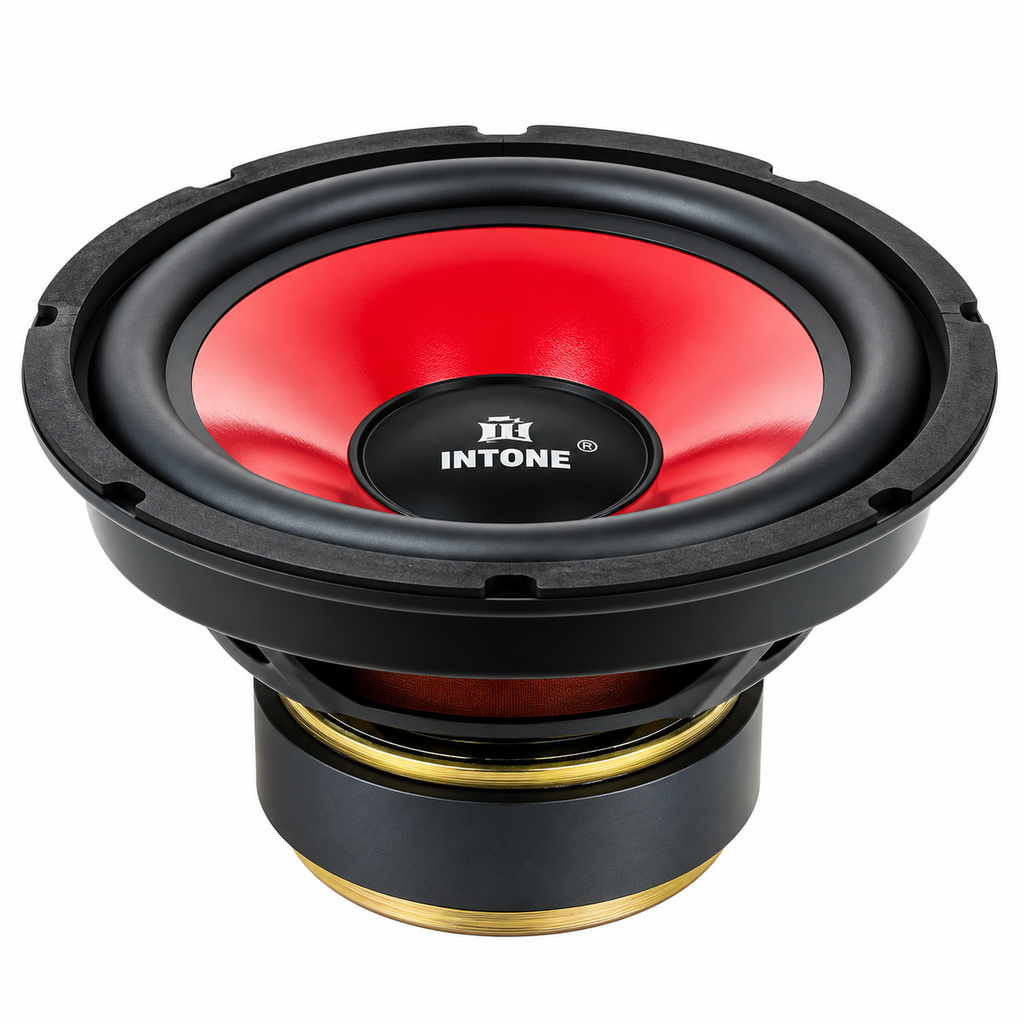
🔧 Prototyping and Engineering Tips from RoboGears
1. Correct the Current 10-Inch Error
This product is:
8 Inch
not 10 Inch.
Ensure every description, specification, SEO field and image text consistently identifies the product as an 8-inch speaker.
2. 4Ω Is the Critical Amplifier-Matching Specification
Nominal impedance:
4Ω
Verify that the amplifier supports a 4Ω speaker load.
3. 100W RMS Is Published
The current product specification explicitly states:
100W RMS
Use this value consistently.
Do not add an unverified peak-power multiplier.
4. Remove the 200W Peak Claim
The current detailed specification lists:
Peak Power: Up to 200W
A manufacturer source or measurement supporting this figure has not been verified.
Until verified, remove it.
5. Don't Require an Exactly 100W RMS Amplifier
The current page says:
Pair the subwoofer with a 100W RMS amplifier
This is unnecessarily rigid.
A speaker does not require an amplifier with exactly the same wattage.
Instead:
Use a suitable 4Ω amplifier and control the output appropriately.
6. A Lower-Power Amplifier Can Be Used
A compatible lower-power amplifier can operate the speaker.
Maximum available acoustic output will simply be limited by the amplifier.
Avoid driving a severely underpowered amplifier into heavy clipping.
7. Higher-Power Amplifiers Require Output Control
A more powerful amplifier can potentially be used, but its gain and output must be controlled so that the speaker's thermal and mechanical limits are not exceeded.
8. Use Low-Pass Filtering
For dedicated subwoofer use:
Audio → LPF → Amplifier → Subwoofer
or use a 2.1 amplifier with a dedicated filtered subwoofer channel.
9. Don't Set One Universal Crossover
The appropriate crossover depends on:
Satellite speakers
Enclosure
Desired sound
Room / installation
Do not advertise one crossover frequency as universally correct.
10. 120mm Magnet Does Not Automatically Mean Higher Efficiency
The magnet diameter is:
120mm
But magnet size alone does not determine speaker efficiency.
Avoid claims such as:
“120mm magnet increases efficiency.”
Sensitivity depends on the complete driver motor and moving system.
11. Paper Cone Does Not Automatically Guarantee “Natural Sound”
The speaker uses a paper cone.
That's a construction specification.
Avoid converting it into subjective guarantees such as:
Natural sound
or:
Superior bass quality
without measurements.
12. Rubber Surround Allows Cone Movement
The rubber surround forms the flexible suspension around the cone.
Avoid claiming that it automatically provides:
Deeper bass
Longer lifespan
Higher power handling
without product-specific evidence.
13. Enclosure Design Matters
Bass performance depends strongly on:
14. “Airtight” Applies Differently to Different Enclosures
The current page says to use an:
airtight enclosure
That wording should be changed.
A sealed enclosure should be properly sealed.
A bass-reflex enclosure intentionally includes a tuned port.
What matters is avoiding unintended air leaks.
15. Don't Guess Port Dimensions
Bass-reflex port design requires:
Enclosure volume
Desired tuning frequency
Driver characteristics
Random port dimensions can worsen performance.
16. Never Connect Directly to DC
Do not connect the speaker directly to:
Battery
12V DC
24V DC
36V DC
48V DC
The speaker connects to an audio amplifier output.
17. Test Before Final Cabinet Assembly
Before closing the enclosure:
Common Troubleshooting
Weak Bass
Check the enclosure, crossover and amplifier output.
Boomy Bass
Check enclosure design, port tuning and EQ.
Mechanical Knocking
Reduce output immediately.
Distortion at High Volume
Reduce amplifier gain and check for clipping.
Rattling
Check the speaker mounting and cabinet panels.
Speaker Smells / Gets Abnormally Hot
Stop operation immediately and inspect the amplifier and speaker.
No Sound
Check speaker continuity, wiring, amplifier output and source signal.
Engineering Principle
For this Intone woofer:
Correct 4Ω Amplifier + Controlled Output + Proper LPF + Suitable Enclosure
matter more than simply matching “100W” to another 100W number.