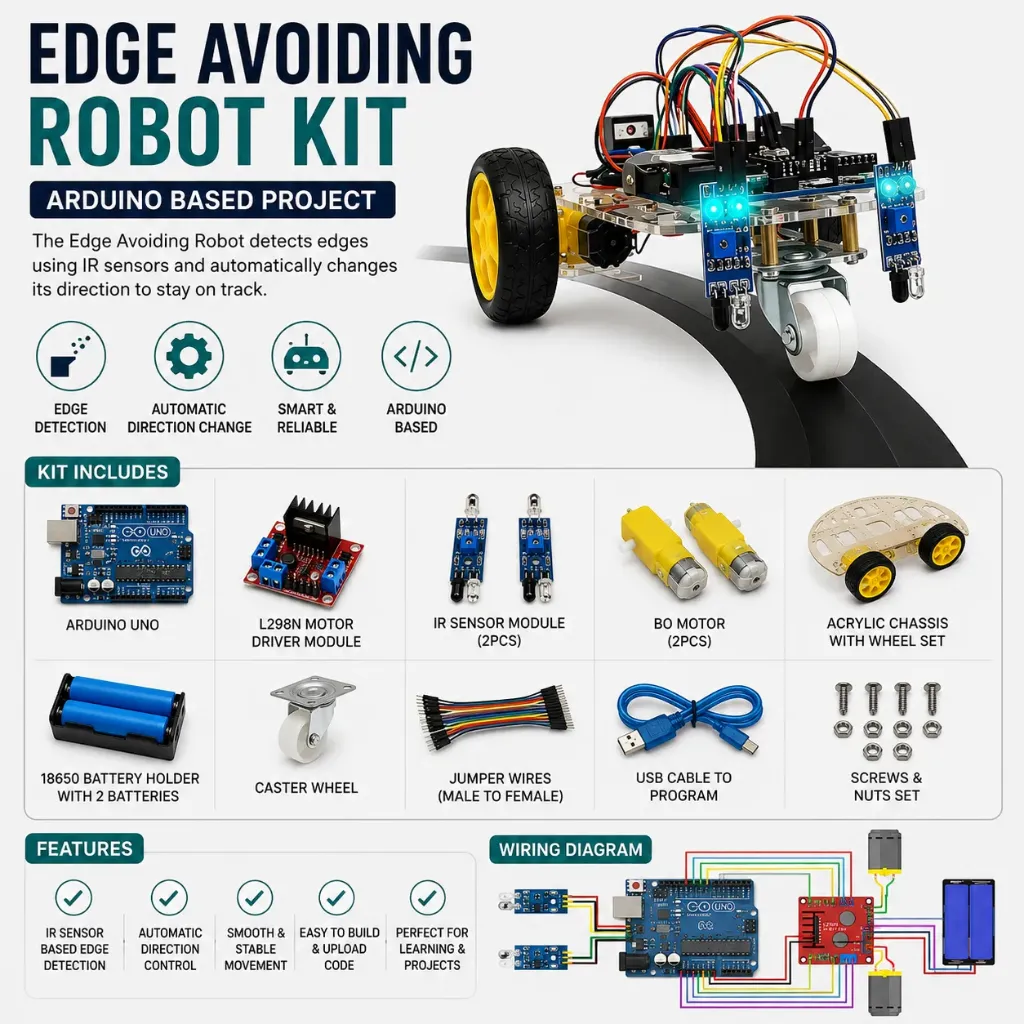
What Is This Product?
The Arduino Edge Avoiding Robot DIY Kit is a ready-to-assemble educational robotics project that teaches students how sensors, microcontrollers, motor drivers and DC motors work together to create an autonomous robot.
The robot uses two IR edge-detection sensors positioned toward the surface below it. During operation, the sensors monitor the surface underneath the robot. When an edge or significant surface boundary is detected, the pre-programmed Arduino UNO compatible board processes the sensor input and controls the motors through the L298N motor driver, allowing the robot to change direction rather than continuing forward and falling from the surface.
Most importantly for beginners, the Arduino supplied with the RoboGears kit is already programmed. You can therefore focus first on mechanical assembly, wiring and understanding how the robot works instead of needing to write the program before the first run.
What Can You Build / Learn With It?
With this kit you can build a functional 2-wheel autonomous edge-avoiding robot.
The finished robot demonstrates several important concepts in robotics:
-
IR-based surface and edge detection
-
Autonomous decision making
-
Arduino digital input/output
-
DC motor control
-
H-bridge motor driving
-
Differential-drive movement
-
Sensor sensitivity adjustment
-
Basic embedded systems
-
Mechanical robot assembly
-
Battery-powered robotics
-
Sensor-to-controller-to-actuator logic
The project is suitable for students who want to move beyond individual Arduino components and understand how a complete robotic system operates.
How Does the Edge Avoiding Robot Work?
The basic control flow is:
IR Sensors → Arduino UNO → L298N Motor Driver → BO Motors → Robot Movement
The IR sensors continuously monitor the surface below the robot.
Normal surface detected:
The Arduino allows the robot to continue moving.
Edge/boundary detected:
The sensor state changes and the Arduino responds according to its programmed logic.
Arduino commands the L298N:
The motor driver changes the movement of the two BO motors.
Robot changes direction:
The robot moves away from the detected edge and continues autonomous operation.
The RoboGears listing confirms forward movement, edge detection, automatic direction change, surface-boundary avoidance and autonomous navigation as supported functions.
Why This Kit?
-
Pre-programmed Arduino included — no coding required for initial operation
-
Complete educational robotics project rather than individual loose modules
-
Uses commonly understood Arduino-compatible hardware
-
Dual IR sensors for edge detection
-
L298N dual H-bridge motor driver
-
2WD differential-drive robot platform
-
Rechargeable 18650 battery-based power system
-
Hands-on mechanical + electronics learning
-
Sensor sensitivity can be adjusted
-
Arduino IDE compatible for future experimentation
-
Components can be reused for other robotics projects
-
Suitable for school and college demonstrations
-
Excellent introduction to autonomous robotics
Key Features
-
Arduino UNO compatible controller
-
Arduino supplied pre-programmed
-
Two IR edge detection sensors
-
L298N motor driver module
-
Two BO/DC geared motors
-
Two-wheel differential drive
-
Castor wheel for chassis support
-
Acrylic robot chassis
-
2 × 18650 Li-ion batteries included
-
Autonomous edge detection
-
Automatic direction changing
-
Adjustable IR sensor sensitivity
-
Arduino IDE compatible for future modification
-
DIY assembly provides practical robotics experience
The controller, sensor system, motor driver, 2WD configuration, batteries and package components are specified on the current RoboGears product page.