FAQ
1. What is the DS4093?
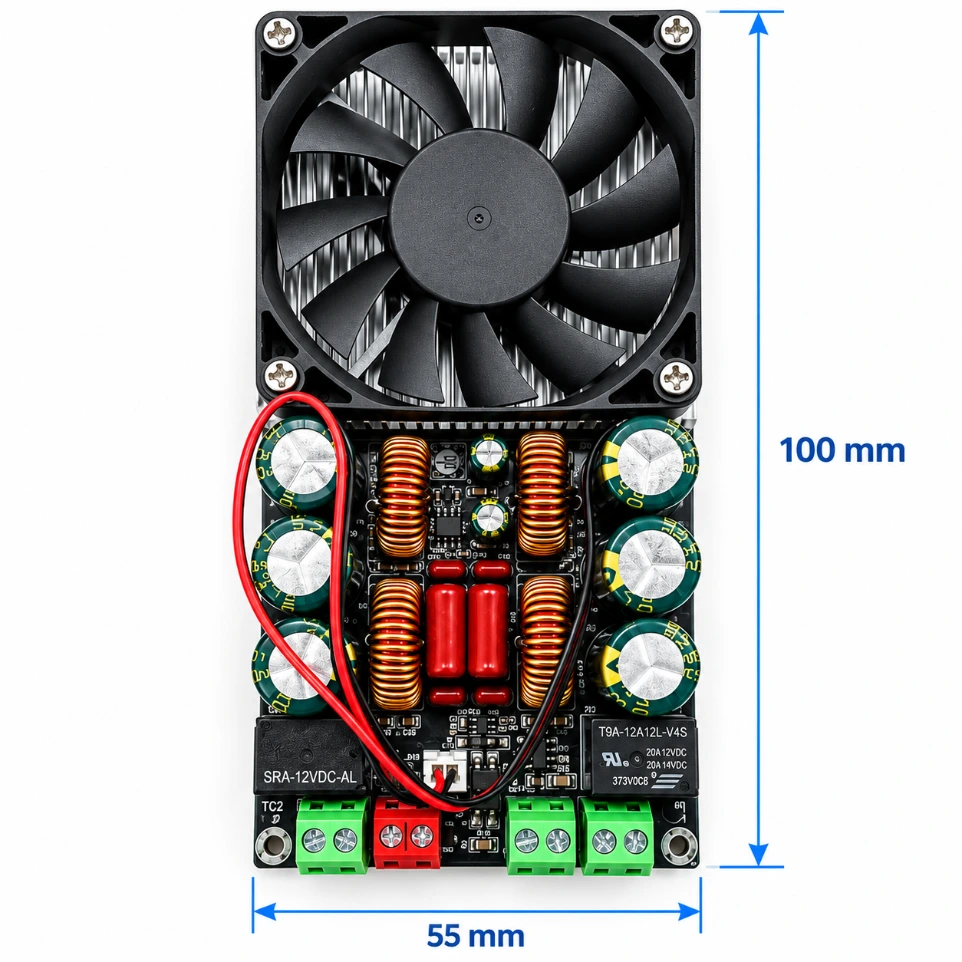
The DS4093 / Gold-B047 is a high-power Class-D 2.0-channel stereo digital amplifier board.
2. What is its advertised output power?
The maximum claimed output is:
600W × 2
or a combined advertised maximum of:
1200W
Actual obtainable output depends on the complete system configuration.
3. Is this a stereo amplifier?
Yes.
It is a 2-channel stereo amplifier with:
4. Is this a 2.1-channel amplifier?
No.
The published specification identifies it as a 2-channel / 2.0 stereo amplifier.
There is no separately specified dedicated subwoofer channel.
5. What input voltage does it support?
The published operating range is:
12V–80V DC
6. Can I power it directly from 230V AC mains?
No.
The amplifier requires a suitable external DC power supply.
Do not connect AC mains directly to the amplifier board.
7. What power supply should I use?
Use a high-quality regulated DC supply within the specified 12V–80V range and with sufficient current capacity for your intended output.
The current product documentation does not specify one universal recommended voltage/current combination.
8. Does the package include the power supply?
No.
The standard package contains the amplifier board only.
9. Does it include speakers?
No.
Compatible speakers must be selected separately.
10. What speaker impedance does it support?
The current RoboGears specification does not publish a verified speaker-impedance range for this exact board.
Verify the appropriate speaker load before attempting high-power operation.
11. Does it have a cooling fan?
Yes.
The DS4093 uses a large aluminium heat sink with an active cooling fan.
12. Can I use it without the fan?
The fan is part of the board's published cooling system.
It should remain operational and unobstructed, particularly during sustained high-power operation.
13. Does it have Bluetooth?
Bluetooth is not specified on the current DS4093 product page.
Do not assume built-in Bluetooth unless your exact board version has verified Bluetooth hardware.
An appropriate external audio receiver can be used if wireless input is required.
14. Which amplifier IC does it use?
The current product documentation does not identify the amplifier IC.
The IC should be verified from the exact board before adding a chip model to the product specification.
15. Does 600W × 2 mean I will always get 1200W?
No.
It is the published maximum claimed rating.
Actual output depends on:
Supply voltage
Available supply current
Speaker load
Input signal
Wiring
Amplifier efficiency
Thermal conditions
16. Can I use it for home audio?
Yes.
The product is intended for applications including HiFi stereo systems, home audio and DIY amplifier projects.
17. Can it be used for PA speakers?
The current listing includes professional PA systems among its intended applications.
The complete system still needs correctly matched speakers, power supply, cooling and wiring.
18. Can it be used with a subwoofer?
The current product page includes subwoofer systems among potential applications, but the DS4093 itself is specified as a 2.0 stereo amplifier, not a dedicated 2.1 amplifier.
A suitable crossover/filter and system configuration may therefore be required for a dedicated subwoofer application.
19. Is an enclosure included?
No enclosure is listed as included.
A suitable ventilated enclosure should be provided for a permanent build.
20. Is this suitable for beginners?
It can be used for DIY audio projects, but because of its wide voltage range and potentially high electrical power, users should understand DC power supplies, speaker matching, wiring, cooling and electrical safety before attempting high-power operation.
Important Safety Note
This is a high-power DIY amplifier module.
Observe correct DC polarity.
Never exceed the specified 80V DC maximum.
Never connect AC mains directly to the amplifier board.
Prevent speaker-output short circuits.
Keep the cooling fan unobstructed.
Use adequately rated wiring and connectors.
Disconnect power before modifying connections.
Disclaimer
The 600W × 2 / 1200W figure is the manufacturer's/listing maximum claimed rating and should not be interpreted as guaranteed continuous RMS output under every operating condition.
Actual output depends on supply voltage, available current, speaker load, signal conditions, wiring and thermal management.
Product appearance, PCB layout and component placement may vary between manufacturing batches while maintaining the intended functionality.